Commercial
Commercial roof repair and replacement
Flat and low-slope roofs on commercial and industrial buildings, re-cover or tear-off, plus inspections and scheduled maintenance for property managers.
Chapter 01
Ponding, open seams and flashing that lets go at the parapet
Most commercial and industrial buildings around Detroit sit under a flat or low-slope roof, and that kind of roof fails in a few predictable places. Water stands in a low spot near a drain until the membrane there blisters or thins. A seam that was sound last year opens a finger's width after another freeze-thaw cycle. Flashing at a parapet wall or around a rooftop unit curb pulls loose, and the ceiling stain shows up three bays away from where the water got in.
Ted Thompson's crews look at the whole roof before anything is written down: the membrane around each drain, every seam, the curbs, the parapet caps and the coping. Small, local damage over sound insulation is a repair, and the estimate says so. Widespread blistering, wet insulation or repairs that keep coming back are a different conversation, and the estimate says that too. Industrial roofing gets the same treatment as a storefront, on a bigger deck, with a free written estimate we will beat if a licensed and insured roofer has quoted you lower.
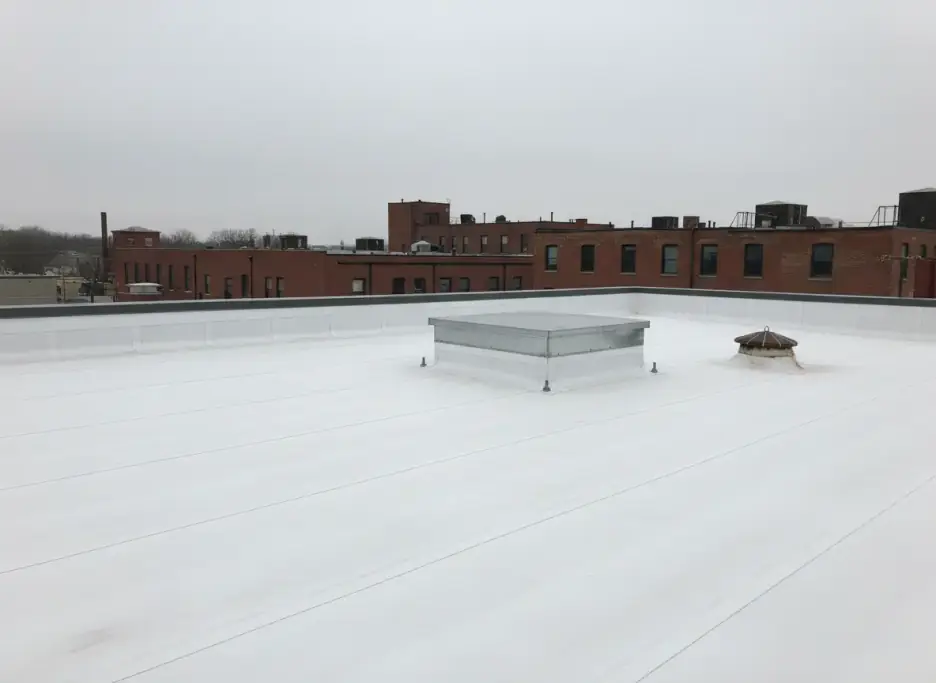
White TPO single-ply membrane on a flat commercial roof beside brick city buildings
Re-cover or tear-off, and which membrane goes down
On a low-slope roof there are two ways forward. A re-cover puts a new membrane over the existing roof when the layers underneath are dry and the deck is sound, which saves the mess and the disposal of a full tear-off. A tear-off strips the roof to the deck when the insulation is wet, the deck has soft spots, or a second layer would load the structure too far. The honest way to know is to look under the surface, and that is what the free inspection is for, before the estimate is written.
The membrane follows the building. TPO is the white, heat-welded single-ply. EPDM is the black rubber sheet. Duro-Last is the prefabricated membrane system we install too, and metal fits where the roof has the pitch for panels. Each has its own page, linked at the bottom of this one. The estimate prices the system you pick, in writing, and names who stands behind it.
Chapter 03
Inspections and maintenance visits for property managers
A property manager with several buildings does not want to hear about a roof for the first time when a tenant calls. T&M Roofing runs inspections and scheduled maintenance programs for that reason: a visit on a calendar, a written note of what was found, and small repairs estimated while they are still small. A commercial roof is also a walkway for every other trade, so each visit looks for the damage they leave behind.
After a hard Michigan winter the first visit matters most, because freeze-thaw is what opens seams and lifts flashing. Call (313) 600-4538, Monday to Saturday, 8 to 6, and the office will set up a free inspection. We are fully licensed and insured, Michigan licence #262400794, and our own work carries a 10-year labor warranty. Bring the last roofer's written estimate, if you have one, and we will beat it.
Google 4.4 from 47 reviews, and more than 20 years on Detroit roofs.
Scheduled maintenance visit
What a visit checks on your roof
Every visit follows the same sheet, so a manager can compare one building to the next and see what changed since the last walk. Membrane questions are laid out on the TPO and EPDM pages, and a leak that cannot wait is handled on the emergency roofing page.
T&M Roofing LLC · Commercial and industrial
Maintenance visit sheet
Michigan licence #262400794
- SeamsOpen edges, lifted laps, and welds or tape that have let go after a freeze-thaw winter.
- Drains and scuppersDebris in the outlet, and the membrane around it where water stands longest.
- Curbs and rooftop unitsFlashing at the base of every curb, pipe and vent that comes through the roof.
- Parapet flashingCoping, counterflashing and the top edge where the membrane turns up the wall.
- Punctures from HVAC serviceDropped tools, screw heads and scuffs left by other trades on the way to the unit.
- PondingLow spots that are still holding water a day after the rain or the thaw.
Findings are written down after the visit. Any repair that comes out of it gets its own free written estimate before work starts.