Commercial
TPO roofing
White single-ply TPO membrane with hot-air welded seams, flashed at curbs, drains and parapets. Duro-Last systems installed too.
Chapter 01
What TPO is: a white membrane welded into one sheet
TPO is a single-ply roofing membrane, usually white, rolled out across insulation board and joined at the seams with hot air. The weld is the point. Instead of relying on glue or tape, the overlapping edges of two sheets are heated until they fuse, so the seam becomes part of the membrane. The white surface reflects sunlight rather than soaking it up, which is why you see it on the flat roofs of warehouses, shops and offices in Detroit, Warren and Southfield.
T&M Roofing installs TPO on commercial and industrial buildings, along with Duro-Last prefabricated membrane systems. The choice between them comes down to the roof's shape, its penetrations and what you want the written estimate to cover. Ted Thompson's office will walk the roof for free, look at the drains and curbs, and put the system, the insulation and the flashing details on paper before anyone starts.
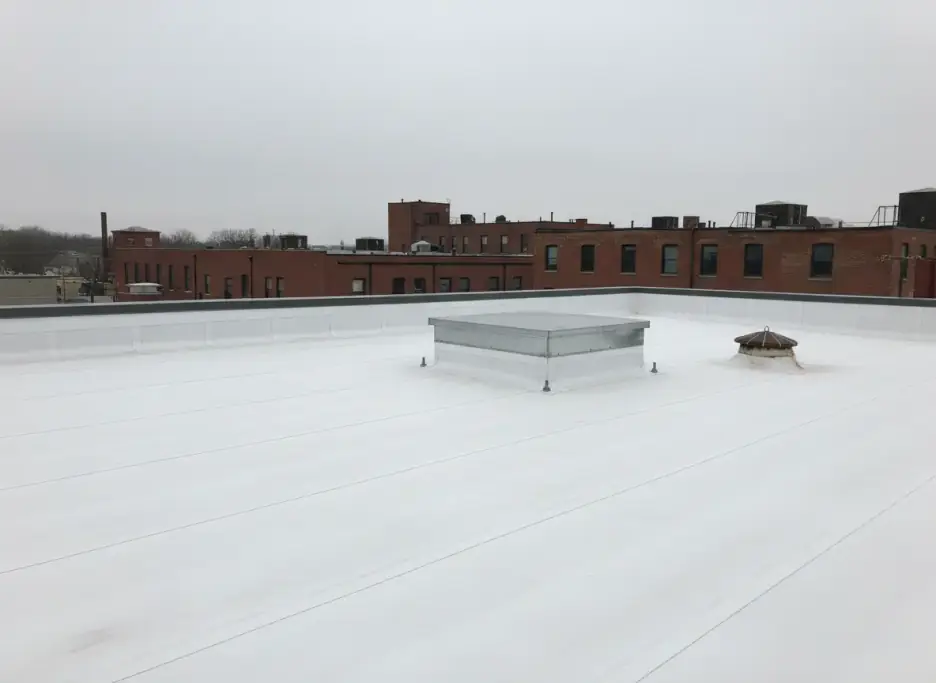
White TPO membrane on a flat roof with a brick building behind it
How a TPO roof goes down on a Detroit building
The order of work matters more than the membrane. First the old roof is torn off or prepared for a re-cover, and any wet insulation or soft deck is dealt with, because a new membrane over a wet layer just holds that moisture in. New insulation board goes down in staggered layers. The TPO is then fastened or fully adhered to it and rolled out in sheets, with the overlaps lined up so water runs across a lap instead of into it.
Welding comes next. A hot-air welder runs along each seam, and the crew probes the weld afterward to find any spot that did not fuse. The details take the longest: every drain, rooftop unit curb, pipe and parapet wall gets its own flashing, cut and welded to the field membrane. Those details are where a flat roof leaks later, which is why a careful crew slows down for them.
Chapter 03
Keeping a TPO roof sound after the crew leaves
A TPO roof can stay quiet for a long time and then a seam, a flashing weld or a puncture lets water in. Checking those on a schedule is easier than finding them with a bucket. After a Michigan winter the walk covers the seams, the drain areas, the walls where the membrane turns up, and any spot where a technician has been on the roof.
Foot traffic and HVAC service are the usual cause of punctures, since a dropped tool or a screw left on the membrane can cut it. T&M Roofing runs inspections and scheduled maintenance programs for property managers, and every repair gets a free written estimate first. Our work carries a 10-year labor warranty, and the office is at (313) 600-4538, Monday through Saturday.
Robert Werth, Google: "They listened to our needs, made suggestions and executed a plan within budget."
Membrane comparison
TPO next to EPDM and metal
Same four questions, three systems. The full write-ups are on the EPDM and metal roofing pages.
Colour and surface
- TPO
- White, reflective and smooth.
- EPDM
- Black rubber that takes on heat.
- Metal
- Coated steel or aluminum panels, ribbed or flat-seamed.
Seams
- TPO
- Welded with hot air into one sheet.
- EPDM
- Primer and tape or adhesive, with few seams on large sheets.
- Metal
- Lapped or interlocking panels, sealed at the trim and fasteners.
Michigan snow and freeze-thaw
- TPO
- Meltwater runs to the drains. Check the welds after winter.
- EPDM
- Stays flexible in the cold. Snow tends to leave sooner.
- Metal
- Sheds snow fast. Watch what sits below the eave.
Typical building
- TPO
- Flat and low-slope commercial and industrial roofs.
- EPDM
- Flat roofs, additions and low-slope commercial buildings.
- Metal
- Pitched homes and commercial buildings with slope.